What Doris Lemngole’s Millrose Record Reveals About the Kenya–NCAA Pipeline

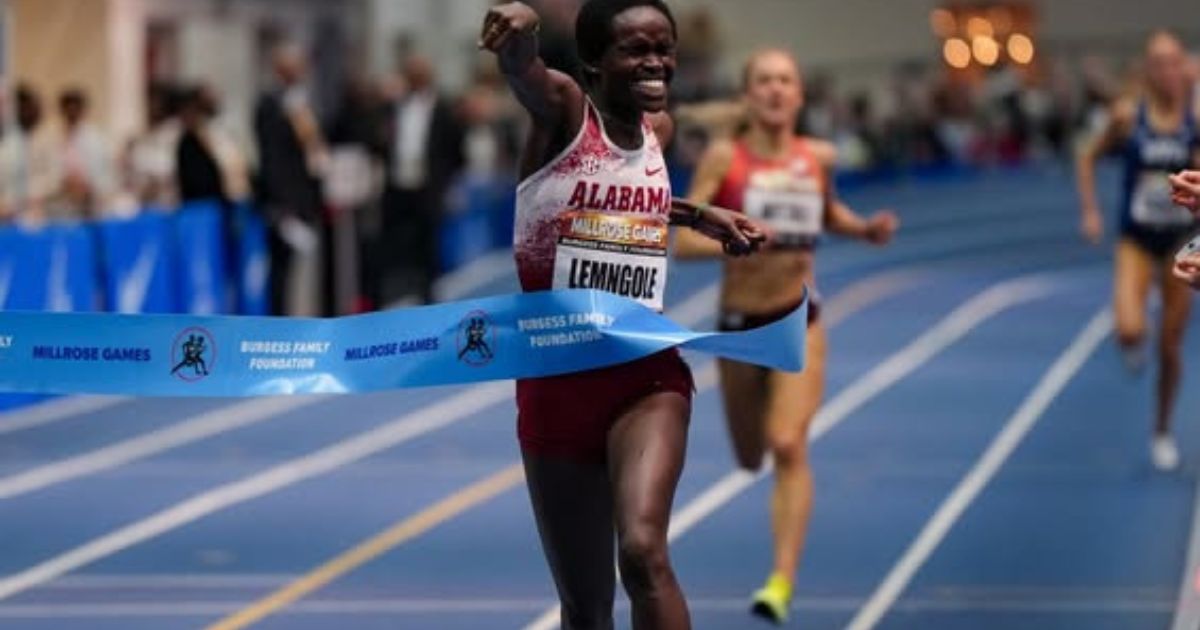
Doris Lemngole’s 8:31.39 performance at the 118th Millrose Games was widely reported as a record-breaking run. But viewed through a wider lens, the race offers something more consequential: a case study in how the Kenya–NCAA pipeline is quietly reshaping elite distance running.
Rather than approaching the result as an isolated athletic feat, Lemngole’s performance invites analysis of development systems, career pathways, and the evolving relationship between Kenyan endurance traditions and U.S. collegiate structure.
The NCAA 3000m indoor record did not fall because of reckless front-running or brute force. It fell because of controlled patience, tactical discipline, and environmental familiarity—hallmarks of athletes shaped within the NCAA system.
Lemngole spent most of the race positioned just off the lead, allowing others to dictate the tempo while she conserved energy. Her decisive move came only in the final lap, where her acceleration separated her not only from collegiate rivals but also from professional athletes in the field. This was not a gamble; it was a rehearsed outcome.
That distinction matters. It suggests a runner who has been developed to read races, not just survive them.
Why the NCAA Matters in This Context
For decades, Kenyan distance success has been built on early specialization, high mileage, and rapid transition to the professional circuit. That pathway has produced legends—but it has also produced instability, burnout, and uneven career longevity.
Lemngole represents a different model. Her NCAA development has provided a stable competition calendar, consistent access to high-performance facilities, medical oversight, and race environments that reward tactical execution as much as aerobic capacity. This has allowed her to evolve as a complete athlete, capable of adapting across events and race formats.
The NCAA, in this context, functions not as a detour from elite performance, but as a controlled incubator.
A Broader Shift in Kenyan Athlete Development
Lemngole is not an anomaly; she is part of a gradual shift. Increasingly, Kenyan athletes—particularly women, are entering the NCAA system at formative stages of their careers. The benefits are structural rather than incidental: exposure to diverse racing styles, strategic coaching, and a long-term performance horizon.
What makes Lemngole’s Millrose performance significant is that it demonstrates how this pathway can produce world-level outcomes without early professionalization. Her indoor 3000m time sits comfortably within global elite standards, despite being achieved within a collegiate framework.
This challenges the assumption that peak performance requires immediate immersion in the professional circuit.
Reframing the Meaning of the Record
In isolation, an NCAA record is a statistical achievement. In context, it becomes a signal. Lemngole’s time was not just faster than the previous mark, it arrived in a race where multiple athletes also dipped under the old record, indicating a broader elevation of competitive standards. The NCAA environment did not suppress elite performance; it facilitated it.
This suggests that the collegiate system, when navigated strategically, can coexist with—and even enhance—international competitiveness.
Implications Beyond One Athlete
For Kenya, the implications are structural. The success of athletes like Lemngole strengthens the argument for multiple elite pathways, rather than a single, early professional route. It opens space for education, measured development, and athlete agency, particularly for young women navigating limited domestic opportunities.
For the global athletics ecosystem, it reinforces the NCAA’s role as a legitimate high-performance environment, not merely a developmental tier.
And for young runners watching from West Pokot, Eldoret, or Iten, it reframes what is possible: success does not require haste; it requires alignment between talent, system, and time.
Conclusion
Doris Lemngole’s Millrose Games performance should not be remembered solely as a race that ended in a record. It should be remembered as evidence—evidence that the Kenya–NCAA pipeline is producing athletes who are tactically refined, globally competitive, and structurally supported.
In that sense, the most important finish line Lemngole crossed was not painted on the Armory track. It was conceptual: a shift in how elite Kenyan distance running can be built in the modern era.